


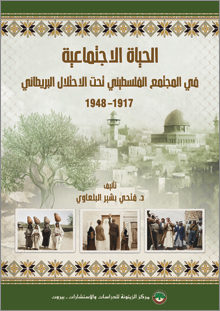
Al-Zaytouna Centre for Studies and Consulting has published a new book titled Social Life in the Palestinian Society Under the British Occupation 1917–1948, by Fathi Bashir al-Bal‘awi.
This new book carries a profound human dimension alongside its scholarly significance, as its author, Fathi Bashir al-Bal‘awi, was killed in an Israeli strike on Deir al-Balah in October 2023 before its publication. Consequently, the work stands as both a testament to Palestinian society and a poignant reminder of the price Palestinian intellectuals pay in defending their memory and identity.
At a time when the Palestinian people are enduring a genocidal war targeting both human life and cultural memory, documenting Palestinian social and cultural life acquires a significance that extends beyond academic inquiry, becoming an act of cultural resistance. Within this context, Al-Zaytouna Centre publishes Social Life in the Palestinian Society Under the British Occupation 1917–1948, one of the most important documentary studies reconstructing the Palestinian social landscape in its human and cultural dimensions; its celebrations and holidays, clothing and dialects, seasonal traditions, social relations, songs, daily rituals, family structures and deeply rooted collective memory.
Furthermore, the book possesses notable historical and political significance, as it offers a nuanced analysis of political transformations and their impact on the structure of Palestinian society and everyday life. Consequently, from its opening pages, the reader is presented with a vivid panoramic portrait of Palestine during the late Ottoman period and the era of British occupation, revealing a society marked by social diversity, cultural richness and deeply rooted human continuity.
| Click here to download Chapter Four: >> Social Life in the Palestinian Society Under the British Occupation 1917–1948 (Chapter 4)(Arabic)  (76 pages, 1.3 MB) (76 pages, 1.3 MB) |
| Publication Information Arabic– Title: Al-Hayat al-Ijtima‘iyyah fi al-Mujtama‘ al-Filastini Tahta al-Ihtilal al-Baritani (Social Life in the Palestinian Society Under the British Occupation 1917–1948). – Author: Dr. Fathi Bashir al-Bal‘awi – Published in: 2026 – Pages: 512 – Paperback Copy Price: $22 – Soft Copy Price: $9.99 – ISBN: 978-614-494-068-6 |
 |
Available on:  ||
||  ||
|| ||
|| ||
||
The 512-page book is divided into six richly documented chapters, each shedding light on a distinct aspect of Palestinian life. It examines how Palestinians lived across villages, cities and Bedouin communities, while also tracing the social relations that shaped families and clans. In addition, it highlights the role of markets, guesthouses, cafés and homes as vital spaces of social interaction, communication and cultural exchange.
Furthermore, the book takes readers on a compelling journey through the fabric of Palestinian society, exploring customs surrounding engagement, marriage and popular wedding celebrations, as well as rituals associated with childbirth, circumcision and death. At the same time, it provides a meticulous account of traditional Palestinian dress, including women’s embroidered thobes and their symbolic motifs alongside traditional men’s attire. Consequently, the work captures both the depth of Palestinian cultural identity and the richness of its geographic and social diversity.
The book also devotes substantial attention to the role of Palestinian women, presenting them as integral participants in political, social, cultural and media spheres. In this regard, it underscores their contributions to national struggle, community life and the preservation of Palestinian identity, thereby challenging reductive stereotypes that have often framed Palestinian society during this period.
Equally important, the work offers a rich account of Palestinian folk culture, including songs, chants, traditional dances, oral narratives, proverbs and popular games. In addition, it situates these cultural expressions within a broader social context by examining religious seasons, as well as both Islamic and Christian holidays, which together formed part of Palestine’s shared cultural fabric.
Beyond its cultural focus, the book further explores the economic and social structures of Palestinian society. It documents the everyday lives of peasants, Bedouins, laborers and merchants, while also analyzing patterns of agricultural landownership and the structural transformations introduced under Ottoman reforms and later British rule. Finally, it traces these developments into the early emergence of the Zionist project and its efforts to assert control over Palestinian land.
The book is marked by a rigorous academic style and a rich foundation of sources, documents and historical records, which collectively enhance its value as a scholarly reference. At the same time, it maintains a fluid and accessible narrative, thereby appealing not only to specialists and researchers but also to general readers, journalists and those engaged with history, heritage and socio-cultural studies.
More importantly, its significance extends beyond its documentary and academic contribution. It presents Palestine in its broader human and civilizational dimensions, namely Palestine as lived experience, encompassing people, homes, memory, customs and everyday practices, rather than as a reality reduced to images of war and destruction. In this sense, the book does not merely document a historical period; rather, it reconstructs the contours of an entire society and, in doing so, offers future generations a vivid window into a people who, despite repeated catastrophes and wars, have preserved their cultural presence and collective memory.
In the context of the ongoing genocide in GS and amid the systematic targeting of libraries, universities, cultural institutions and manuscripts, the publication of this book by Al-Zaytouna Centre, originally written in GS, constitutes a deliberate effort to safeguard Palestinian collective memory from erasure. Accordingly, it serves as a documented affirmation, grounded in evidence and testimony, that Palestine has never been a land without a people. Rather, it has long been the homeland of a living and deeply rooted society with a cumulative social, cultural and civilizational history spanning generations.

Leave A Comment