
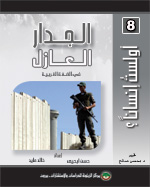
Al-Zaytouna Centre for Studies and Consultations has published a book, part of the Am I Not a Human? series, in Arabic, examining the Separation Wall in the West Bank. It offers a comprehensive and methodologically grounded account of the hardships inflicted by the Israeli occupation on the Palestinian people, combining scholarly documentation with a narrative that appeals to both reason and conscience. The Separation Wall in the West Bank was edited by Dr. Mohsen Mohammad Saleh and authored by Hasan Ibhais and Dr. Khaled ‘Ayed.
>> Click to Download the Full Book  (122 pages, 3.1 MB)(Arabic) (122 pages, 3.1 MB)(Arabic) |
| Publication Information
Arabic – Title: Al-Jidar al-‘Azil fi al-Daffah al-Gharbiyyah (The Separation Wall in the West Bank) – Prepared by: Hasan Ibhais & Dr. Khaled ‘Ayed – Edited by: Dr. Mohsen Mohammad Saleh >> Click to Download the Full Arabic Book |
 |
Available on: 




The 120-page book seeks to illuminate the hardships endured by the Palestinian people as a result of Israel’s construction of the Separation Wall in the WB, examining its economic, social, health, educational and other repercussions.
It first traces the evolution of the idea of constructing the wall within Israeli strategic thinking, and subsequently provides an overview of the Separation Wall that Israel began building in mid-2002, outlining its objectives, phases, route and structural components. Furthermore, it examines the position of international law on the wall’s construction, reviewing in this context the advisory opinion of the International Court of Justice, which deems the wall a violation of international conventions and agreements and calls upon the international community to assume its responsibility in compelling Israel to comply with them.
The book further challenges Israel’s claim that the wall was constructed for “security” purposes, demonstrating that its route is closely linked to political calculations, settlement expansion, and the appropriation of agricultural land and water resources. It also analyzes the consequences of the wall’s construction, highlighting both direct impacts, such as land confiscation and home demolitions, and the broader effects of movement restrictions and the isolation imposed on communities on both sides of the wall, with significant repercussions for Palestinian daily life.
In addition, the book devotes a separate chapter to the wall surrounding Jerusalem, often referred to as the “Jerusalem envelope.” It also examines the experience of the town of Bil‘in in resisting the wall, presenting it as a model of Palestinian popular resistance.
The book is distinguished by its clear and accessible style, which combines precision and academic rigor with carefully selected images and accompanying narratives. In doing so, it provides a comprehensive account of Israel’s Separation Wall and its infringement on the Palestinian people’s right to their land. Furthermore, it demonstrates how the wall functions as a barrier separating Palestinians from fundamental rights, including freedom of movement, access to education, and medical care, among others. This occurs at a time when the world widely proclaims its commitment to human rights, the protection of human dignity and freedom, and the right to live peacefully in one’s land and home, yet largely turns a deaf ear to the realities faced by Palestinians.

Leave A Comment