


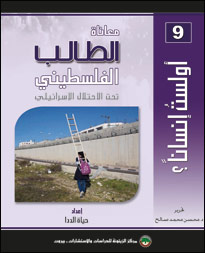
Al-Zaytouna Centre for Studies and Consultations has published a book, part of the Am I Not a Human? series, in Arabic, examining the suffering of Palestinian student under Israeli occupation. It offers a comprehensive and methodologically grounded account of the hardships inflicted by the Israeli occupation on the Palestinian people, combining scholarly documentation with a narrative that appeals to both reason and conscience. The Suffering of the Palestinian Student Under Israeli Occupation was edited by Dr. Mohsen Mohammad Saleh and authored by Hayat al-Dada.
The 95-page book examines the hardships faced by Palestinian students under Israeli occupation. It reviews the most significant international legal provisions concerning the right to education in both peace and wartime, while also analyzing the impact of Israeli policies that undermine Palestinian education. Furthermore, it addresses the effects of daily attacks, the blockade and the Separation Wall on Palestinian students.
>> Click here to Download the Full Arabic Book  (98 page, 8.1 MB)(Arabic) (98 page, 8.1 MB)(Arabic) |
| Publication Information
English – Title: Mu‘anat al-Talib al-Filastini Tahta al-Ihtilal al-Israeli (The Suffering of the Palestinian Student Under Israeli Occupation) >> Click here to Download the Full Arabic Book |
 |
Available on: 




The book further highlights Israeli violations against Palestinian students at checkpoints and roadblocks, as well as the Separation Wall in the WB, which has significantly intensified their hardships. These practices expose students to various forms of abuse, including body searches, physical and verbal assaults, and restrictions that impede students’ and teachers’ access to schools and universities, in addition to obstructing the delivery of essential educational materials. Palestinian detainees have also been deprived of their right to education.
Moreover, the book examines Israeli practices toward Palestinian curricula. Israel has pursued policies aimed at undermining Palestinian education by removing and modifying elements of the curriculum to serve its occupation objectives, thereby distancing students from their historical legacy and distorting their history.
In Jerusalem, Israel has altered the Arabic curricula to align with its policies, introducing the Bagrut certificate in place of the General Secondary Education Certificate (Tawjihi), which is not recognized by Hebrew universities. At the same time, school construction has been frozen and numerous obstacles have been imposed on obtaining permits for new schools. Consequently, natural population growth has not been accommodated, resulting in severe classroom overcrowding.
The book further examines the deterioration in educational standards caused by Israel’s repeated school closures and the security measures imposed on them, which seek to intimidate both students and teachers.
It also refers to several wars launched by Israel against the Gaza Strip, which have significantly disrupted the Palestinian educational process, in addition to the extensive damage resulting from the blockade imposed on the territory since 2007.

Leave A Comment