
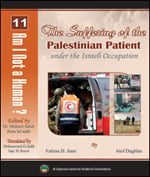
Al-Zaytouna Centre for Studies and Consultations has published a book, part of the Am I Not a Human? series, in Arabic, examining the suffering of Palestinian patient under Israeli occupation. It offers a comprehensive and methodologically grounded account of the hardships inflicted by the Israeli occupation on the Palestinian people, combining scholarly documentation with a narrative that appeals to both reason and conscience. The Suffering of the Palestinian Patient Under Israeli Occupation was edited by Dr. Mohsen Mohammad Saleh and authored by Fatima ‘Itani and Atef Daghlas.
The 127-page book explores the hardships faced by Palestinian patients resulting from Israeli violations against them and the Palestinian health sector. It examines healthcare disparities between Jews and Arabs, the use of patients in medical experiments, and the effects of the blockade and crossing closures on Gaza Strip (GS) patients, including instances of exploitation. It also considers the impact of Israeli checkpoints and the Separation Wall on West Bank (WB) patients. The authors also discuss the conditions of ill detainees in Israeli prisons, and the deliberate targeting of medical personnel.
>> Click here to Download the Full Book  (132pages, 7.5 MB) (132pages, 7.5 MB) |
| Publication Information Arabic – Title: Mu‘anat al-Marid al-Filastini Tahta al-Ihtilal al-Israeli (The Suffering of the Palestinian Patient Under Israeli Occupation) – Prepared by: Fatima ‘Itani and Atef Daghlas – Edited by: Dr. Mohsen Mohammad Saleh – Published in: 2011 (1st Edition) – Paperback: 127 pages, 17*21 cm, – Price: 4 $>> Click here to Download the Full Book (132 pages, 7.5 MB) |
 |
Available on: 




The book further highlights numerous cases in which individuals endure compounded suffering, stemming both from their illnesses and from Israeli-imposed obstacles that restrict access to essential medical care. It underscores the strained conditions of health institutions serving Palestinians under these constraints. Specifically, it examines delays at Israeli checkpoints, the Separation Wall gates and border crossings, which impede patients, the injured and pregnant women from reaching medical facilities. Between the start of Al-Aqsa Intifadah and 31/1/2011, 401 Palestinians reportedly died as a result of these checkpoints. The book further explores the worsening health crisis in GS due to the Israeli blockade imposed since mid-2007, which has caused severe shortages of medicines, medical equipment, and other critical supplies for hospitals, medical devices and ambulances, particularly fuel and electricity, leading to the deaths of 380 Palestinians to date.
The book further presents comparative statistics highlighting the disparity in healthcare provision between Israelis and Palestinians. It notes that per capita health expenditure in 2008 reached $2,145 in Israel, compared to just $165.5 in Palestinian Authority (PA) areas. Likewise, in 2009, the number of hospital beds in Israel reached 42,119, whereas Palestinian hospitals had only 5,058 beds.
In addition, the book examines practices in Israeli hospitals involving medical experimentation on Palestinian patients, including children, the elderly and individuals with mental disorders, without obtaining informed consent from the patients or their legal guardians, and in contravention of international standards governing medical research. It also addresses Israel’s use of detainees in its prisons to test potentially dangerous experimental drugs, as well as the alleged removal of organs from deceased Palestinians for transplantation, including for soldiers in the Israeli army.
It further indicates that Israel has systematically pursued a policy of deliberate medical neglect against detainees in its prisons, depriving them of adequate healthcare. Consequently, the number of ill detainees has increased, and many conditions have significantly deteriorated, often persisting even after release and, in numerous cases, resulting in death; indeed, the number of detainees who have died in Israeli prisons since 1967 exceeds 51.
The book also addresses restrictions on patients’ ability to travel abroad for treatment, as well as coercive practices whereby access to medical care in Israel is conditioned on collaboration, including providing information on relatives or neighbors sought by Israeli authorities or assisting in their apprehension.
It further discusses Israeli attacks on medical personnel, encompassing direct gunfire, physical and verbal assaults, obstruction of access to the wounded and sick, and the targeting of ambulances and medical facilities during military operations.
The book also provides extensive, up-to-date statistical and documentary evidence on Israeli violations against Palestinian patients and the Palestinian health sector. Notably, it incorporates testimonies, photographs, and charts that enhance the analysis and present it in a rigorous and compelling manner.

Al-Zaytouna Centre for Studies & Consultations, 27/4/2011
Leave A Comment