


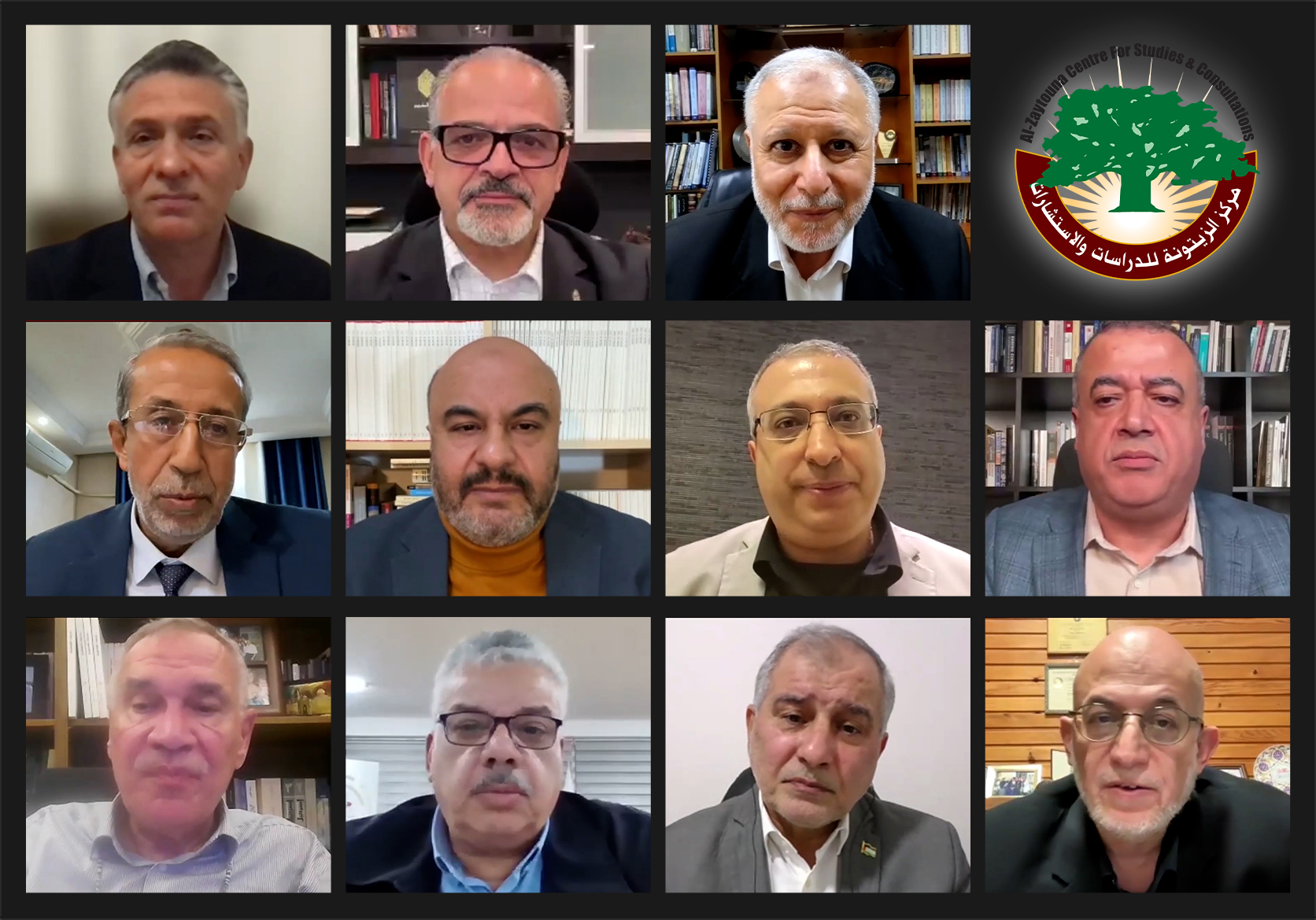
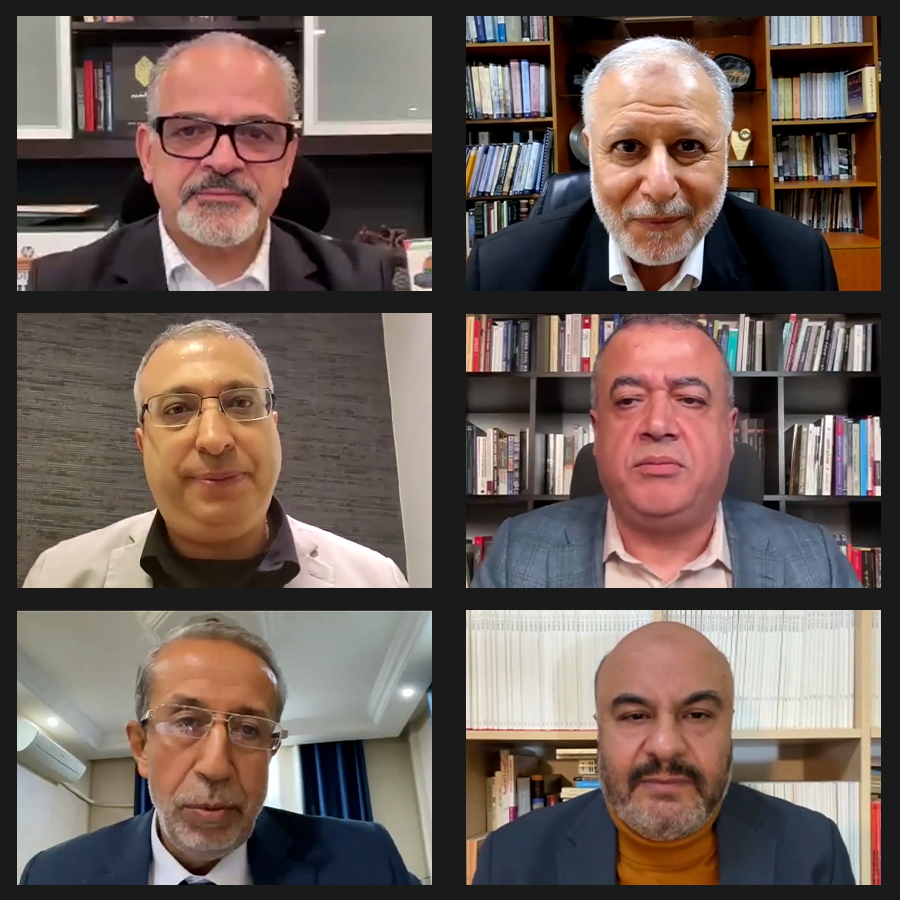
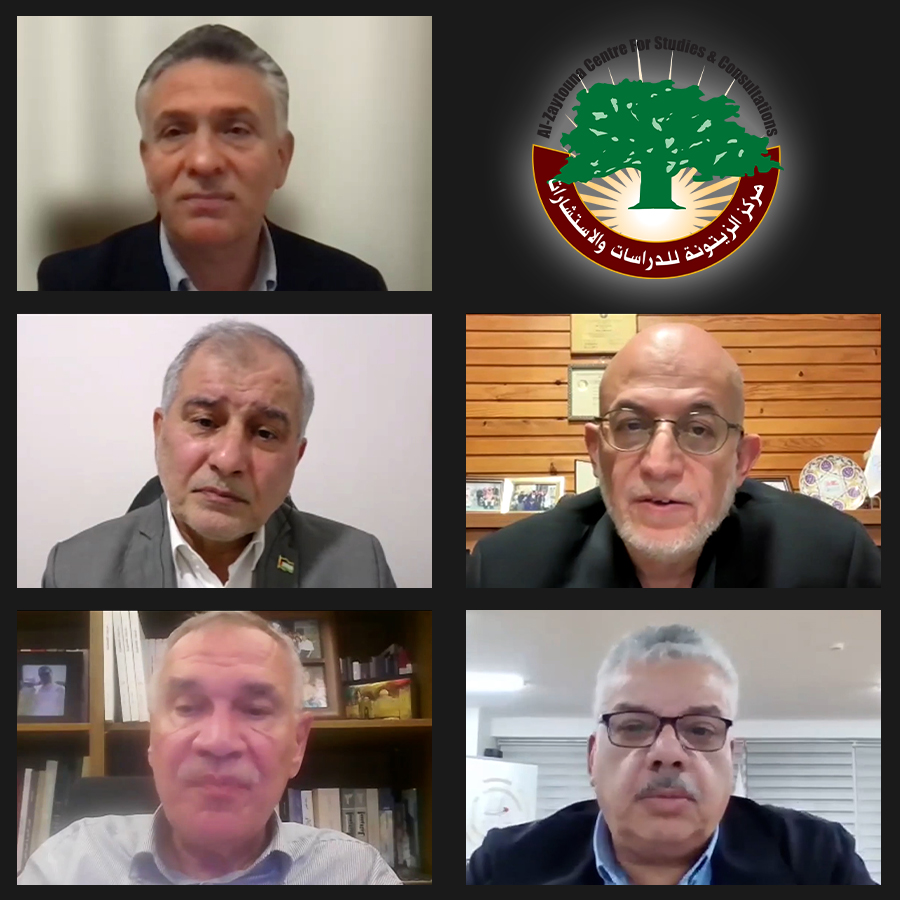
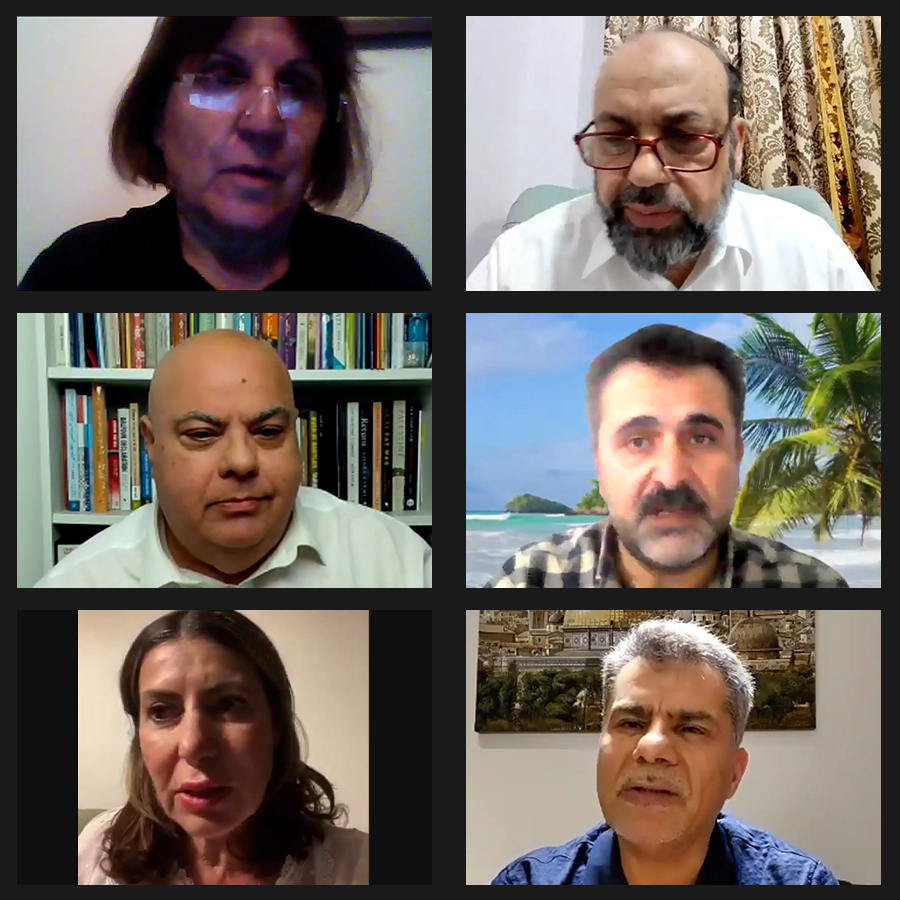
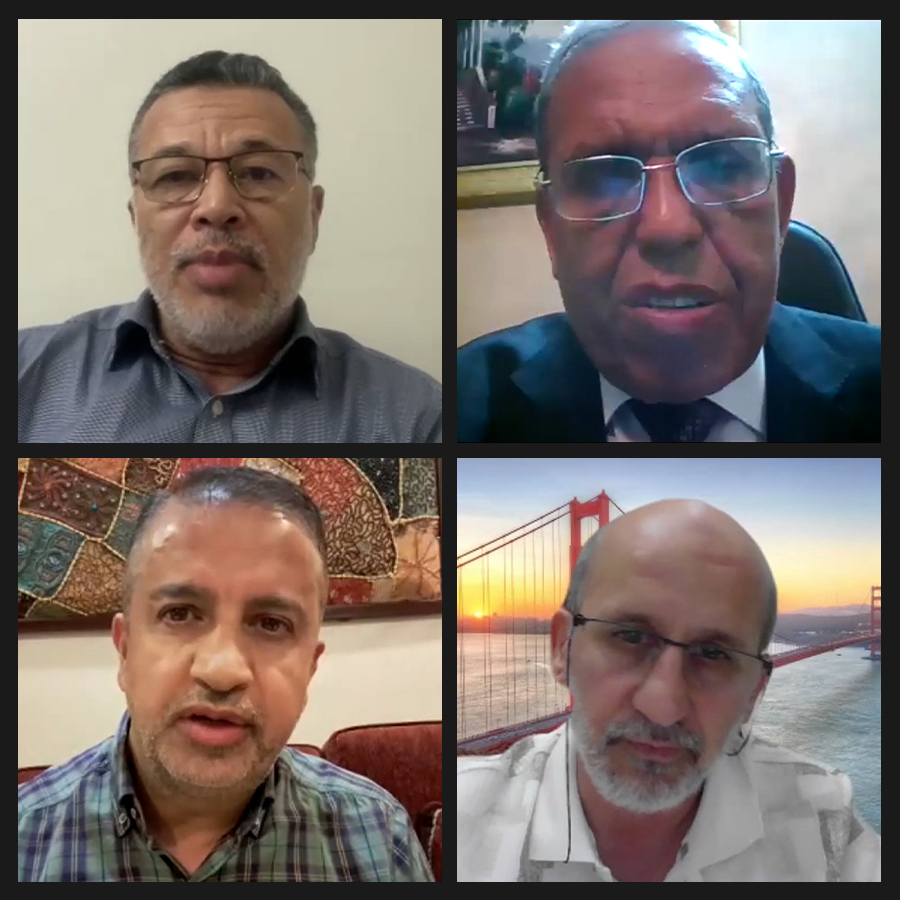
Al-Zaytouna Centre for Studies and Consultations convened a virtual panel discussion via Zoom, titled “Palestinians Abroad and Regional and International Strategic Transformations in Light of Operation al-Aqsa Flood.” The event brought together a distinguished group of experts and scholars.
The panel, convened over two sessions, examined the impact of regional and international strategic transformations on Palestinians abroad. It further sought to analyze how they have responded to and repositioned themselves in light of current developments, while also addressing prospects for strengthening their popular engagement and collective effectiveness.
In the first session, chaired by Khalid Turaani, Dr. Muhannad Mustafa, Director-General of Mada al-Carmel – Arab Center for Applied Social Research in Haifa and an expert on Israeli affairs, presented his paper examining the shifts in Israel’s political and military behavior following Operation al-Aqsa Flood. He explained that these shifts are increasingly linked to Israel’s domestic landscape and the global perception of it after the war, rather than the identity of its leadership.
Mustafa highlighted that the international isolation experienced by Israel constitutes a structural weakness, despite the government’s efforts to portray it as a temporary state affecting only the current leadership. He noted that the 2015 military doctrine defined victory in terms of achieving political objectives and imposing a ceasefire on Israeli terms. However, Operation al-Aqsa Flood upended this framework, making military strength the determinant of the political horizon. He argued that the event exposed the philosophical flaw in the Israeli deterrence concept and undermined the notion that “force produces peace,” asserting that Israel is returning to a phase of colonial expansion accompanied by increasing isolation.
The second paper, presented by Dr. Ibrahim Fraihat, associate professor in international conflict resolution at the Doha Institute for Graduate Studies, examined US foreign policy toward Palestine. He argued that the current paradigm of US foreign policy differs fundamentally from that pursued between 1993 and 2017. While previous administrations endorsed the two-state solution through negotiations, albeit with a consistent bias toward Israel, Trump introduced a new framework centered on immediate and personal gains, thereby disregarding international law and legitimacy.
Fraihat further explained that Trump’s approach relied on exerting pressure on the weaker party to compel its acceptance of imposed conditions, in contrast to the traditional negotiation-based approach that sought to recalibrate power asymmetries in favor of the weaker side. Within this framework, the envisioned Palestinian state would be demilitarized, accompanied by the annexation of parts of the WB, non-recognition of Jerusalem, the legalization of settlements, and the dismissal of the right of return.
He added that while the international position continues to uphold the two-state solution, the Arab approach has regressed toward limited arrangements such as the Abraham Accords. Fraihat concluded that this transformation opens new prospects for Palestinians abroad, given the shifts in public opinion in the US and Europe, as well as within the Democratic Party, developments that may grant them a more consequential role than before.
‘Atef al-Joulani, an expert in political and strategic affairs, presented the third paper, which examined the implications of Operation al-Aqsa Flood for Arab and Islamic engagement with the Palestine issue. He underscored that the operation constituted a major turning point in regional dynamics over the past two years, with its repercussions evident across three levels: official, political movements and parties, and popular.
At the official level, the operation restored the Palestine issue to the forefront of regional attention, driven by widespread public frustration with weak governmental positions, the exposure of the peace process’s failure, and heightened concern over regional stability, particularly in Egypt and Jordan. Moreover, Israel’s aggressive conduct prompted several states to diversify their defensive strategies.
The operation also reinforced the role of non-state armed movements, such as the Palestinian resistance factions, Hizbullah, and Ansar Allah, reviving the notion of a unified front. Islamic movements expressed political and humanitarian solidarity with the Palestinian people, while enhancing coordination among diverse Arab ideological currents. At the popular level, the operation revitalized Arab and Islamic public spheres, deepened youth awareness of the Palestine issue, and mitigated sectarian polarization, as all components of the resistance took part in confronting Israel.
The fourth paper, presented by Hossam Shaker, an expert on European affairs, media studies and the Palestine issue, examined the global repercussions of Operation al-Aqsa Flood. Shaker argued that, over the two years since the operation, Palestinians have made profound sacrifices in resisting Israel and its machinery of violence. He noted that the ongoing genocide has exposed the failure of the international community and its disregard for international law, while simultaneously reinvigorating global attention to the Palestine issue and generating a spectrum of political and media responses. However, he observed that these political reactions have neither ensured protection for Palestinians nor secured their rights, as they have often been marked by evasion and efforts to minimize Israel’s obligations, thereby confronting Palestinians with a profound dilemma. Shaker further noted that Israel’s brutality has been laid bare before the world, emphasizing that international solidarity has manifested through diverse forms of protest, strikes, and artistic and media campaigns. Despite the limited nature of official responses, he viewed this as a significant achievement. He concluded by underscoring the need to advance Palestinian discourse to more effectively expose violations and assert rights, while leveraging the momentum of solidarity and legal advocacy to safeguard Palestinians’ inalienable rights.
In the second session, chaired by Dr. Adeeb Ziadeh, Prof. Dr. Sami al-Arian, an expert on US foreign policy and international relations and the director of Center for Islam and Global Affairs (CIGA) at Istanbul Zaim University, presented the fifth paper, offering an analytical reading of the regional environment through an international lens. He underscored that global powers shape the overarching trajectory and exert decisive influence over the behavior of regional actors as well as Palestinians abroad. He further highlighted the diminishing role of the Palestine Liberation Organization (PLO) and the consequent shift of political weight toward the Palestinian domestic sphere. He argued that the unipolar moment following the collapse of the Soviet Union inaugurated a phase of US hegemony that restructured the region by fostering regional alignments such as the “moderation and normalization” axis in opposition to the Axis of Resistance, while simultaneously seeking to contain the influence of Russia and China.
Al-Arian concluded that Palestinians alone cannot determine the outcome of the struggle and urged Palestinians abroad to work toward five core objectives: rejecting the adversary’s aims, halting normalization, maintaining steadfast presence on the land, sustaining the spirit of resistance, and preserving global popular support.
Majed al-Zeer, President of the European Palestinian Council for Political Relations (EUPAC), presented the sixth paper, which explored the implications of Operation al-Aqsa Flood for Palestinians abroad within the international arena. He observed that this environment is marked by multidimensional legal, cultural, and political frameworks, all of which shape the experiences of Palestinians living and engaging within these societies.
Al-Zeer emphasized that Operation al-Aqsa Flood has produced a qualitative shift in global engagement with the Palestine issue over the past two years, particularly in Western Europe. The magnitude and depth of popular, political, legal and cultural engagement have expanded considerably, elevating the Palestine issue to the forefront of international attention and, in some cases, surpassing other priorities, such as Ukraine.
Moreover, he highlighted that new media and the immediacy of live coverage from GS have been instrumental in raising awareness and strengthening support, while influential Palestinians have increasingly entered European political and media spheres, thereby becoming significant actors in safeguarding Palestinian rights. Although challenges persist, Al-Zeer noted that these coincide with opportunities for enhanced political and popular coordination. He concluded by underscoring the importance of leveraging the progress achieved over the past two years to secure sustained international support for the Palestine issue.
In the seventh paper, presented by Hisham Abu Mahfouz, Acting Secretary-General of the Popular Conference for Palestinians Abroad (PCPA), which addressed the development of the popular performance of Palestinians abroad regarding the Palestine issue in light of recent developments, he emphasized that Operation al-Aqsa Flood has produced major strategic transformations that have reshaped the Palestinian landscape and imposed new challenges and obligations on Palestinians abroad.
He highlighted the need to develop the role of the Palestinian diaspora in a manner commensurate with the sacrifices of our people in Gaza Strip (GS) and West Bank (WB), transforming their role from mere supporters into a leading entity capable of establishing a national political reference. He further noted that significant opportunities and challenges exist, including the immense popular energy, global, Arab and Islamic solidarity, and the role of younger generations, alongside the challenges posed by the fragmentation of Palestinian reference points and the dominance of entrenched leadership inside Palestine.
He underscored the necessity of strengthening national and strategic alliances, activating formal political participation, building stable popular structures, and launching training programs for youth in digital media mobilization. He also stressed that solutions require a unified popular reference, representative institutions, effective communication with the interior, and legal and media protection for activists, in order to transform the Palestinian diaspora into a strategic, influential force on the international stage.
Mu’in al-Taher, Director General of the Arab Center for Research and Studies – Jordan, presented the eighth paper, titled “Activating the Political Role and Representation of Palestinians Abroad within the Official Palestinian Institution.” He emphasized that the war against Palestinians has not ceased following Operation al-Aqsa Flood; it continues in GS, WB, Lebanon and Syria, and could extend to Iran, signaling challenging years ahead.
He highlighted the importance of activism in the Arab, Muslim, and Western public spheres, noting the growing international solidarity with the Palestine issue. This, he argued, necessitates leveraging these opportunities to shift the balance of power in the coming years. He further explained that institutions representing Palestinians abroad must collaborate with the PLO, Palestinian factions, the national movement, and the diaspora communities to rebuild the Palestinian national movement in a pluralistic and democratic manner, encompassing factions, national figures, and popular movements.
He also proposed the establishment of a global virtual Palestinian community to unify the diaspora, provide accurate demographic data on Palestinians, and facilitate the election of democratic leadership aimed at supporting the resilience of the Palestinian people and enhancing their political and strategic influence on the international stage.
The sessions concluded with significant interventions and comments from a range of experts and specialists on the presented papers, as well as responses and clarifications from the presenters addressing the questions and observations of the discussants.

Leave A Comment