
 • How did the League of Arab States and Arab states deal with the Israeli aggression against the Gaza Strip during 2024 and 2025, and what were their positions on ending the war, displacement, reconstruction, and normalization?
• How did the change in Israeli security doctrine affect Arab national security, as well as the trajectories of normalization and settlement process?
• Did official Arab positions move beyond rhetoric and statements to concrete measures?
• How did Arab peoples express their support for Palestine, and what impact did this popular mobilization have on official policies?
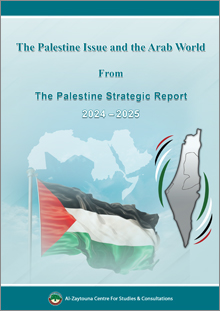
These and other questions are addressed in a comprehensive reference study issued by Al-Zaytouna Centre for Studies and Consultations, which constitutes Chapter Six of The Palestine Strategic Report 2024–2025. The study examines Arab positions on the Palestine issue, the performance of the League of Arab States, and the roles of the neighboring, Mashreq, Gulf, and Maghreb states, in addition to trends in popular engagement during 2024 and 2025. The Centre makes the chapter available for free download through its website.
The study demonstrates that the official Arab position toward the Israeli aggression against the Gaza Strip (GS) was generally characterized by weakness, and that positions supportive of Palestinian rights remained, to a large extent, within the rhetorical sphere, without translating into effective action capable of stopping the war. At the same time, the study documents the roles of resistance-supporting environments in Lebanon, Yemen, and Iraq, as well as the engagement of Arab peoples within the spaces available to them.
The study documents the positions of the League of Arab States during five summits held in 2024 and 2025, and the emphasis they placed on ending the war, delivering aid, rejecting displacement and annexation, reconstructing the GS, and supporting the establishment of a Palestinian state with East Jerusalem as its capital. It also addresses the League’s adherence to the settlement process and the two-state solution, its support for the leadership of the Palestine Liberation Organization and the Palestinian Authority, and the gap between the resolutions issued and their actual level of implementation.
At the level of the major Arab states, the study presents Egypt’s role in Palestinian internal communications and mediation efforts to end the war, alongside Qatar’s role in the negotiations. It also documents the Egyptian and Jordanian positions rejecting the displacement of Palestinians, and discusses the political and security considerations that shaped Jordan’s position, the transformations witnessed in Syria, and the repercussions of the war on Lebanon and the two issues of the resistance’s weapons and the Palestinian presence there.
The study examines the positions of Saudi Arabia and the Gulf states, including their differing approaches toward resistance and normalization, alongside the roles of Iraq, Yemen, and the Maghreb states. It also documents the continuation of political and commercial relations between a number of Arab states and Israel during the war, in contrast to the stalled trajectory of normalization with Saudi Arabia in light of its position regarding the two-state solution.
At the popular level, the study documents the diversity of forms of engagement with the Palestine issue through demonstrations, protest rallies, boycott campaigns, fundraising, and media activity.
It demonstrates that this mobilization expanded in countries where greater spaces for expression were available, but remained limited in its impact on changing government policies, due to official and security restrictions, alongside other political factors and local circumstances.
The study concludes that the gap between official and popular positions continues to persist, and finds that 2024 and 2025 revealed the limited ability of the official Arab system to influence the course of the war. It also provides a forward-looking assessment of the concentration of Arab efforts on rehabilitating the Palestinian Authority to return to administering the GS, and anticipates that the trajectory of normalization will face further setbacks as a result of the growing Israeli threats to the national security of Arab states.
Al-Zaytouna Centre makes this chapter available for free download, providing an analytical reading and forward-looking assessment that help in understanding official and popular Arab positions, the roles of Arab states, and the transformations related to the Palestine issue during 2024 and 2025.
| Click here to download: >> The Palestine Issue and the Arab World During the Two Years of Operation al-Aqsa Flood, 2024–2025 … A Chapter from The Palestine Strategic Report Available for Free Download  (101 pages, 2.3 MB) (101 pages, 2.3 MB) |
| Click here to download: >> Summary of The Palestine Strategic Report 2024-2025: Monitoring, Analysis and Evaluation of Developments in the Palestine Issue (64 pages, 4.9 MB) |

Leave A Comment