
 – What are the key developments in Israel’s domestic landscape? How has the political map evolved, and how has Operation al-Aqsa Flood reshaped Israeli politics?
– What are the main demographic trends, including changes in the Jewish population in Palestine and worldwide, and what are the conditions of the Palestinians of 1948?
– What do the latest economic indicators reveal about GDP, per capita income, government spending, exports, imports and the impact of the war on the Israeli economy?
– How has Israel adapted militarily to the war on Gaza Strip (GS) and other military campaigns? How have the Israeli military’s structure and leadership evolved, and what changes have occurred in military spending, arms production and defense exports?
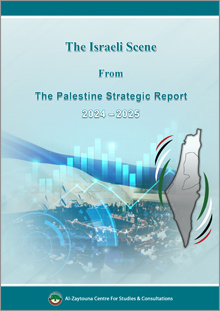
These questions, and many others, are addressed in a comprehensive reference study published by Al-Zaytouna Centre for Studies and Consultations as Chapter Five of The Palestine Strategic Report 2024–2025. Offering an in-depth analysis of Israel’s political, societal, economic, demographic and military landscape, the study is available for free download on the Centre’s website.
Drawing on the latest official statistics, demographic data, and public opinion surveys, the chapter provides a rigorously documented assessment of the major developments that shaped Israel during 2024–2025. It examines the impact of the war on GS across multiple dimensions of Israeli society and state institutions, while assessing their likely future trajectories.
The study concludes that Israel experienced one of its most severe political and social crises during 2024–2025. The repercussions of Operation al-Aqsa Flood and the war on GS deepened internal divisions, eroded the broad consensus that initially accompanied the war, and intensified debate over the performance and political future of Benjamin Netanyahu’s government.
The study also maps Israel’s evolving political landscape, showing that political competition is increasingly dominated by the right in its various forms. Rather than a contest between the right and the left, the main rivalry is now between Netanyahu’s governing coalition and an opposition led largely by the right and center-right, while opinion polls point to declining prospects for the coalition to retain its parliamentary majority.
Moreover, the study argues that the war has reshaped Israel’s political agenda, placing issues such as the state’s identity, constitutional reform, the balance of power among state institutions, Netanyahu’s trial, and the military conscription of the Haredim at the center of electoral politics. At the same time, Israeli opinion polls indicate that internal polarization has become the threat most Israelis view as more serious than external security challenges.
In addition, it provides a comprehensive analysis of Israel’s demographic indicators, noting that its population reached about 10.177 million by the end of 2025, including 7.297 million Jews (71.7%) and 2.147 million Arabs, including residents of East Jerusalem and the Golan. Excluding these two areas, Palestinians of 1948 number about 1.717 million, or 16.9% of Israel’s population.
It further examines global Jewish demographic trends, estimating the worldwide Jewish population at about 15.74 million in 2024. Nearly 85% reside in Israel and the US, which together account for 45.5% and 40% of the global Jewish population, respectively, while overall demographic growth remains relatively slow.
The study also examines the conditions of Palestinians of 1948, highlighting persistent structural discrimination, rising organized crime, violence, and the spread of unlicensed weapons amid inadequate Israeli police responses. These developments have intensified pressures on the Palestinian Arab community inside Israel.
Economically, the study assesses key indicators, showing that the Israeli economy maintained its overall scale despite wartime pressures. GDP reached about $611 billion in 2025, up from $542 billion in 2024, while average per capita income rose to about $61 thousand.
The chapter further examines the war-driven expansion of government spending, noting that Israeli exports fell to about $58.8 billion in 2025, while imports rose to about $95.5 billion, widening the trade deficit. However, the US helped mitigate part of this imbalance through trade surpluses, as well as financial and military support.
Moreover, the study highlights the war’s broader economic impact, including declining investment, business closures, disruptions to key sectors, especially tourism, large-scale reserve mobilization, and increased war-related expenditures. These pressures have posed growing challenges to the Israeli economy, despite its continued overall growth.
The study also devotes a section to military developments, showing that the war on GS and the ensuing multi-front confrontations prompted Israel to reassess its security doctrine and military structure. This included strengthening ground forces and reserves, preparing for multi-front warfare, accelerating arms modernization, and expanding capabilities in air defense, precision munitions, and manpower. It further examines changes within the military establishment, including resignations, dismissals and leadership appointments aimed at assigning responsibility and restructuring the command hierarchy following the failures of 7/10/2023.
Furthermore, the study highlights an unprecedented increase in military spending, alongside expanded arms production and defense procurement. However, Israeli arms exports have faced growing pressure due to boycott campaigns and the cancellation or postponement of deals worth more than $1.3 billion, despite continued US military support that has helped sustain Israel’s capabilities during the war.
The study concludes with projections for Israel’s political landscape in 2026, addressing the future of Netanyahu’s government, the prospects of elections, internal political tensions, and ongoing efforts to reshape the political system. As such, the chapter serves as an important reference for understanding the structural transformations taking place in Israel and their implications for the Palestine issue and the wider region.
Al-Zaytouna Centre invites researchers, media professionals, and those interested in Palestinian and Israeli affairs to download the chapter and benefit from its documented analysis, updated data and statistics, and forward-looking assessment of developments in Israel’s evolving landscape.
| Click here to download: >> Israel After Two Years of War… A Comprehensive Reference Study on the Israeli Landscape from The Palestine Strategic Report 2024-2025  (67 pages, 5.2 MB) (67 pages, 5.2 MB) |
| Click here to download: >> Summary of The Palestine Strategic Report 2024-2025: Monitoring, Analysis and Evaluation of Developments in the Palestine Issue (64 pages, 4.9 MB) |

Leave A Comment