
 • What does the report’s detailed study on Türkiye (case study) examine, and what are its positions toward the Palestine issue, Israeli aggression and the Palestinian resistance?
• What does the report’s detailed study on Iran (case study) examine, and what are its positions toward the Palestine issue, its support for the resistance, and its participation in the war?
• How did Indonesia, Malaysia and Pakistan respond to developments related to the Palestine issue?
• How did the Organization of Islamic Cooperation (OIC) respond to developments in the war on the Gaza Strip (GS) during 2024 and 2025, and what were its main positions toward the Palestine issue?
• How did the war impact relations between Muslim countries and Israel, and how did it affect the trajectory of normalization?
• What were the main manifestations of popular engagement with the Palestine issue in the Muslim world, and what are the future trends in this engagement?
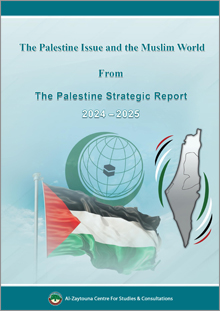
These questions, among others, are addressed in a comprehensive reference study issued by al-Zaytouna Centre for Studies and Consultations, constituting Chapter Seven of The Palestine Strategic Report 2024–2025, entitled “The Palestine Issue and the Muslim World.” The study tracks the positions of non-Arab Muslim countries toward the Palestine issue during 2024 and 2025 by examining the positions of the OIC and the case studies of Türkiye and Iran, alongside a review of the main positions of other states, particularly Indonesia, Malaysia and Pakistan. It also examines popular engagement with the Palestine issue and normalization with Israel.
The study indicates that the Palestine issue enjoys the broadest consensus among non-Arab Muslim countries, despite varying levels of sympathy, solidarity, and support, as well as differences in the nature of relations with Israel from one state to another. It also tracks the positions and interactions of these states in response to developments in the war on GS and the political, humanitarian, and regional repercussions accompanying it.
The study examines the positions of the OIC on the war on GS, including calls to provide international protection for the Palestinian people, ensure Israel’s compliance with the orders of the International Court of Justice, and put an end to the suffering of Palestinians. It also addresses the OIC position on the suspension of funding to the United Nations Relief and Works Agency for Palestine Refugees in the Near East (UNRWA) and its warning of the resulting humanitarian repercussions in the Strip.
The study analyzes the positions of Türkiye and Iran toward the Palestine issue and the war on GS. In the Turkish case, it tracks the development of the official position on the war, relations with Hamas, the position toward Israel, and Türkiye’s political and humanitarian role in GS and the Palestine issue. In the Iranian case, it examines continued support for the Palestine issue and resistance movements and the development of Iran’s position amid the regional confrontations associated with the war.
With regard to other Muslim countries, the study reviews the main positions of Indonesia, Malaysia and Pakistan toward the Palestine issue, alongside developments in their relations with Israel and the trajectory of normalization.
The study also tracks the expansion of popular engagement across the Muslim world in support of the Palestine issue through demonstrations, protest rallies and popular events. Given the scale of this engagement during 2024 and 2025, the study focuses on major events and examples from a number of states, reflecting continued popular support for the Palestinian people.
The study examines normalization and relations with Israel, tracking the continuation of cooperation and economic relations alongside positions rejecting normalization in other Muslim countries. It indicates that the war on GS exposed tensions between political positions and economic interests, with some relations and economic cooperation continuing despite the war, affecting the Palestine issue and the trajectory of normalization.
The study concludes that the Muslim world maintained political and popular support for the Palestine issue during 2024 and 2025, despite variations in solidarity and relations with Israel, as well as differences over normalization and economic and political cooperation. However, this support, particularly at the official level, falls short of what is required to confront the occupation and Israeli aggression.
Al-Zaytouna Centre makes this chapter available for free download, providing an analytical reading of the positions of the Muslim world toward the Palestine issue, the roles of the OIC and non-Arab Muslim countries, popular engagement with the issue, and developments in relations with Israel and the trajectory of normalization during 2024 and 2025.
| Click here to download: >> The Palestine Issue and the Muslim World During 2024 and 2025 … A Study Tracking the Positions of Muslim Countries, Popular Engagement and the Trajectory of Normalization  (60 pages, 1.4 MB) (60 pages, 1.4 MB) |
| Click here to download: >> Summary of The Palestine Strategic Report 2024-2025: Monitoring, Analysis and Evaluation of Developments in the Palestine Issue (64 pages, 4.9 MB) |

Leave A Comment