
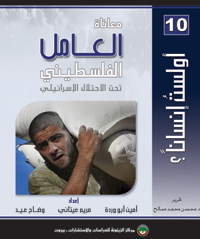
Al-Zaytouna Centre for Studies and Consultations has published a book, part of the Am I Not a Human? series, in Arabic, examining the suffering of Palestinian worker under Israeli occupation. It offers a comprehensive and methodologically grounded account of the hardships inflicted by the Israeli occupation on the Palestinian people, combining scholarly documentation with a narrative that appeals to both reason and conscience. The Suffering of the Palestinian Worker Under Israeli Occupation was edited by Dr. Mohsen Mohammad Saleh and authored by Mariam Itani, Amin Abu Wardeh and Waddah Eid.
The 110-page book examines the hardships faced by Palestinian workers, tracing the history of the labor movement in Palestine and its struggles. It also addresses the direct targeting of Palestinian workers, infrastructure and the agricultural sector. Furthermore, it highlights Israeli policies aimed at constraining the Palestinian economy and analyzes the economic repercussions of restricting workers’ mobility. In addition, it discusses the difficulties faced by Palestinian workers inside Israel and in Israeli settlements.
>> Click here to Download the Full Book  (114 pages, 6.8 MB) (114 pages, 6.8 MB) |
Publication Information Arabic – Title: Mu‘anat al-‘Amil al-Filastini Tahta al-Ihtilal al-Israeli (The Suffering of the Palestinian Worker Under Israeli Occupation) – Prepared by: Mariam Itani , Amin Abu Wardeh, and Waddah Eid – Edited by: Dr. Mohsen Mohammad Saleh – Published in: 2010 (1st Edition) – Paperback: 110 pages, 17*21 cm, – Price: 4 $ – ISBN: * >> Click here to Download the Full Book (114 pages, 6.8 MB) |
 |
Available on: 




The book further notes that addressing the hardships of Palestinian workers effectively means addressing the conditions of roughly one quarter of the Palestinian population in the 1967 occupied territories. The labor force in the West Bank (WB) and Gaza Strip (GS) is estimated at about one million people, representing 24.4% of the total population.
It also argues that since occupying Palestine, Israel has systematically sought to stifle the emergence of an independent Palestinian economy by imposing numerous restrictions that render Palestinians fully dependent on the Israeli occupation economically. According to the book, this dependency is intended to subject Palestinians to humiliating conditions in securing their livelihood and basic needs. In this context, the book highlights the “open-door policy,” designed to expand individual consumption while undermining the productive capacities of Palestinian society. This policy was first introduced in 1968 by Moshe Dayan, who permitted Palestinian workers from the WB and GS, occupied in 1967, to work inside Israel. At the same time, Israel maintained strict control over imports and exports, allowing Israeli goods to flow into WB and GS markets at subsidized prices, while Palestinian products faced severe restrictions and heavy taxation when entering Israeli markets.
The book further notes that between 1970 and 1993, over 35% of the GS’s workforce, and 25–30% of the workforce in the WB, were employed inside Israel. It highlights the harsh working conditions and exploitation they endured, with wages amounting to only 30–50% of those of their Israeli counterparts.
In examining Israeli violations against Palestinian labor, the book provides detailed accounts of the direct targeting of paramedics, medical teams, journalists, farmers and fishermen in GS, including numerous harrowing personal experiences.
For example, it records 1,251 attacks on journalistic teams in the WB and GS from the outbreak of Al-Aqsa Intifadah on 28/9/2000 through the end of October 2010.
The book concludes that Palestinian workers constitute a class whose formation and conditions are entirely controlled by Israel, emphasizing that they are, in essence, closer to individual laborers than to a unified working class or organized economic sectors. It argues that alleviating their suffering cannot rely solely on increased international aid, support programs, or the provision of decent employment; rather, it fundamentally requires an end to the occupation.
The study is particularly notable for its rich and up-to-date statistical and documentary evidence of Israeli violations against Palestinian workers, complemented by testimonies and photographs that strengthen the analysis and present it in a compelling and persuasive manner.

Al-Zaytouna Centre for Studies & Consultations, 29/3/2011
Leave A Comment