
 – How does the Israeli economy dominate the Palestinian economy in the West Bank (WB) and Gaza Strip (GS) under occupation?
– How has Israel’s GDP grown to more than 35 times that of Palestine?
– Why do 86% of the Palestinian Authority’s (PA’s) exports go to Israel, while 56% of its imports come from Israel?
– What have been the economic repercussions of Operation al-Aqsa Flood and the Israeli aggression on GS?
– What do the latest indicators reveal about employment, unemployment, and poverty in WB and GS?
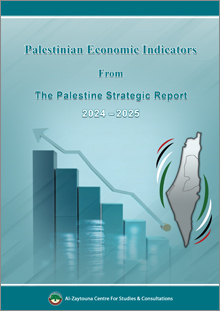
These questions are answered in a rigorously documented study published by Al-Zaytouna Centre for Studies and Consultations. Drawing on extensive statistical evidence, the study demonstrates how the Israeli war on GS, coupled with Israel’s occupation policies and restrictions in WB, reshaped the Palestinian economy during 2024–2025. To support researchers and interested readers, the Centre is making the section on the economic indicators of the WB and GS from The Palestine Strategic Report 2024–2025 available for free download on its website.
Using a comprehensive, systematic, and evidence-based approach, the study examines the principal economic indicators and developments in the WB and GS. It documents the profound transformations experienced by the Palestinian economy during 2024–2025 amid Israel’s genocidal war on GS and the intensification of Israeli restrictions and measures in WB. These developments generated severe shocks that affected GDP, per capita income, the labor market, productive sectors, public finance, foreign trade and international aid.
The findings reveal a stark economic divergence between the WB and GS. Average GDP per capita in the WB stood at approximately $3,857 in 2024, rising marginally to about $3,905 in 2025. In contrast, GDP per capita in the GS collapsed from $970 in 2023 to around $161 in 2024, a decline of 83.4%, before recovering only slightly to approximately $212 in 2025. Consequently, the gap in average GDP per capita between the WB and GS widened to nearly 24 times in 2024 and remained about 18 times in 2025.
Labor market indicators are equally alarming. The unemployment rate in the WB rose to 31.4% in 2024 before declining modestly to 27.5% in the fourth quarter of 2025. Meanwhile, the GS witnessed the near-total collapse of its labor market, reflecting the scale of the economic and humanitarian catastrophe inflicted on the Strip.
The study also traces the trends in GDP, developments in the agricultural, industrial, construction and services sectors, foreign trade, the PA’s public finances, public debt and international aid. It highlights the structural fragility of the Palestinian economy, its deepening dependence on the Israeli economy, the weakness of the domestic productive base, mounting pressures on public finances, and the devastating impact of the war on Gaza’s productive capacity.
Reflecting the Palestinian economy’s declining relative weight, the study shows that Palestinian GDP as a percentage of Israeli GDP fell from 3.8% in 2020 to 2.8% in 2025, underscoring the widening economic gap between the two economies.
Beyond documenting losses and economic decline, the study offers an analytical assessment of the Palestinian economy’s future prospects. It argues that recovery and reconstruction depend on ending the Israeli aggression, lifting the blockade, and reopening border crossings, while simultaneously addressing structural constraints and economic dependency. It further advocates a national development strategy that strengthens domestic production, expands access to Arab and international markets, and reduces reliance on the Israeli economy.
This material is drawn from the chapter entitled “Palestinian Demographic and Economic Indicators,” the second chapter of The Palestine Strategic Report 2024–2025. It was written by Dr. Raed Hillis and academically edited by Prof. Dr. Mohsen Mohammad Saleh.
The Palestine Strategic Report 2024–2025 is the fourteenth in a series published by Al-Zaytouna Centre for Studies and Consultations over the past two decades. Over time, the series has become a key reference for specialists and those interested in the Palestine issue, owing to its comprehensive coverage of developments over a two-year period, its adherence to rigorous academic and professional standards, and its extensive use of up-to-date data and statistics, supported by numerous tables and figures, alongside strategic analysis and forward-looking assessments.
Al-Zaytouna Centre is making this material available for free download in order to serve researchers, academic institutions, economic and media organizations, and others interested in Palestinian affairs. It provides a thoroughly documented reference for understanding the transformations that shaped the Palestinian economy during 2024–2025, the impact of war and occupation on its productive and financial structures, and the prospects for recovery, reconstruction, and sustainable development.
| Click here to download: >>Palestinian Economic Indicators: Free Section from The Palestine Strategic Report 2024-2025  (42 pages, 6.2 MB) (42 pages, 6.2 MB) |
| Click here to download: >>Summary of The Palestine Strategic Report 2024-2025: Monitoring, Analysis and Evaluation of Developments in the Palestine Issue (64 pages, 4.9 MB) |

Leave A Comment