
 • How has Operation al-Aqsa Flood reshaped the Palestinian internal scene?
• What do opinion polls reveal about Palestinians’ views of the Palestinian Authority (PA), Fatah, Hamas and the resistance factions? What do they indicate about the most popular Palestinian presidential candidate?
• How has the Palestine Liberation Organization (PLO) performed? And how has the PA performed in the West Bank (WB) and in relation to Gaza Strip (GS)?
• Why has Palestinian internal dialogue stalled? And why do the leaderships of the PLO and the PA insist on excluding resistance forces from elections?
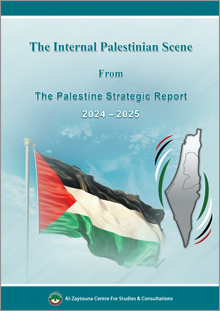
These questions and others are addressed in a comprehensive reference study published by Al-Zaytouna Centre for Studies and Consultations. The study constitutes Chapter One of The Palestine Strategic Report 2024–2025 and examines developments in the Palestinian internal scene and the interactions among Palestinian actors during 2024 and 2025. It documents the war’s repercussions for the PA, the PLO, Palestinian factions, internal relations and visions for the “day after” in GS. The study is available to researchers and those interested in the topic for free download through its website.
The study argues that Operation al-Aqsa Flood and its repercussions represented the most significant and influential development in the Palestinian internal scene, while the PA and the PLO faced challenges in managing the situation and adapting to its developments. Moreover, disagreements over war management and the future of GS became an additional factor that deepened the Palestinian schism and weakened prospects for national consensus.
The study examines three major challenges faced by the governments of Mohammad Shtayyeh and Mohammad Mustafa, namely international pressure to reform and rehabilitate the PA’s institutions, the repercussions of the financial crisis, and the management of the GS file.
In this context, it documents the formation of Mohammad Mustafa’s government, described as a “government of competence,” on 31/3/2024, with humanitarian relief, reconstruction and the unification of institutions among its objectives. However, resistance factions viewed its formation as a unilateral step that reinforced exclusive decision-making and called for the formation of a national consensus government resulting from comprehensive dialogue.
At the PLO level, the study documents growing calls to activate the “unified leadership framework” as a transitional step toward incorporating Hamas and the Islamic Jihad movement in Palestine (PIJ) into the PLO, as well as calls to convene a unifying PNC to rebuild institutions on democratic foundations. Moreover, the chapter examines the “Beijing Declaration” of July 2024, signed by 14 Palestinian factions, which called for the formation of an “interim national reconciliation government” to manage Palestinian affairs in the WB and GS and unify institutions in preparation for elections. However, efforts to implement the declaration encountered continued schism, political disagreements and external pressures.
The study presents the findings of opinion polls conducted by the Palestinian Center for Policy and Survey Research in the WB and GS during 2024 and 2025. The independent center, based in Ramallah, revealed clear shifts in Palestinian public attitudes. The poll results indicate a general trend of significantly increased public support for Hamas. Moreover, Hamas outperformed Fatah and President Mahmud ‘Abbas by a wide margin in terms of satisfaction with performance, presidential and legislative voting preferences, and overall support for factions, while Marwan Barghouti emerged as a leading contender in the presidential race. In contrast, the figures reflected widespread dissatisfaction with ‘Abbas’s performance, as the percentage of respondents calling for his resignation ranged between 80% and 88%, alongside a widespread perception of corruption within the PA.
The study argues that these indicators reveal shortcomings in the leadership, political, and representational structures, as well as a gap between the leadership and the public, placing the Palestinian scene before what it describes as a severe “crisis of representation.”
The chapter concludes that 2024 and 2025 left significant repercussions that are likely to shape the Palestinian scene in the coming years, amid the continued schism, the growing political, security and economic challenges, and the increasing impact of external factors on the future of the Palestine issue and the Palestinian national project.
Al-Zaytouna Centre makes this chapter on the internal Palestinian scene available for free download, given its analytical reading and forward-looking perspective, which contribute to understanding ongoing developments in the Palestinian internal scene, public opinion trends, and the challenges facing the Palestinian arena.
| Click here to download: >> Developments in the Palestinian Internal Scene During the Two Years of Operation al-Aqsa Flood, 2024–2025 … A Chapter From The Palestine Strategic Report, available for free download  (48 pages, 1.2 MB) (48 pages, 1.2 MB) |
| Click here to download: >> Summary of The Palestine Strategic Report 2024-2025: Monitoring, Analysis and Evaluation of Developments in the Palestine Issue (64 pages, 4.9 MB) |

Leave A Comment