
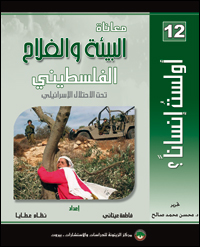
Al-Zaytouna Centre for Studies and Consultations has published a book, 12th in the series Am I Not a Human?, in Arabic, examining the suffering of Palestinian environment and farmer under Israeli occupation. It offers a comprehensive and methodologically grounded account of the hardships inflicted by the Israeli occupation on the Palestinian people, combining scholarly documentation with a narrative that appeals to both reason and conscience. The Suffering of the Palestinian Environment and Farmer Under Israeli Occupation was edited by Dr. Mohsen Mohammad Saleh and authored by Fatima ‘Itani and Nitham ‘Ataya.
The 112 page-book casts light on the suffering of the Palestinian farmer caused by the Israeli occupation. It also exposes the impact of the Israeli violations and practices on the Palestinian environment in general.
>> Click here to Download the Full Book  (116 pages, 6.7 MB) (116 pages, 6.7 MB) |
| Publication Information Arabic – Title: Mu‘anat Bi’ah wa al-Fallah al-Filastini Tahta al-Ihtilal al-Israeli (The Suffering of the Palestinian Environment and Farmer Under Israeli Occupation) – Prepared by: Fatima ‘Itani and Nitham ‘Ataya – Edited by: Dr. Mohsen Mohammad Saleh – Published in: 2013 (1st Edition) – Paperback: 112 pages, 17*21 cm, – Price: $4 >> Click here to Download the Full Book |
 |
Available on: 




The book addresses the most important Palestinian and international laws and regulations related to the protection of the environment only to show how Israel ignores these laws and violates the minimal Palestinian environmental rights thus confiscating lands, destroying forests, uprooting trees and depleting water sources.
The book explores the impact of Israeli settlements on the Palestinian environment, and the ways they contribute to its distortion through the manipulation of Palestinian natural resources and the infringement on all environmental elements.
The book displays the different forms of Israeli aggression on the Palestinian agriculture. These include confiscating lands, building settlements, opening roads, closing agricultural areas for military or security reasons, converting large areas of land into natural reserves that are later confiscated, controlling groundwater, and limiting the quantities that can be pumped for irrigation purposes, in addition to controlling the marketing of agricultural produce.
The book reveals the losses and the size of agricultural destruction during al-Aqsa Intifadah (Uprising), Operation Cast Lead (Al-Furqan) and Pillar of Defense (Stones of Baked Clay).
The book stands out for its accessible style, combining scientific rigor with carefully selected images and narratives, and offering a comprehensive portrayal of the Palestinian environmental reality under Israeli occupation.
The book explores the impact of the Separation Wall on the Palestinian environment. It has shattered large agricultural areas, caused soil erosion, and the uprooting of lots of trees, in addition to the accumulation of dust on trees and agricultural lands resulting from the construction of the Wall, which affected their productivity negatively.
The book also addresses the issue of Israeli factories and their impact on the Palestinian environment. In this context, it talks about the pollution caused by chemical industries, and the production of toxics, like aluminum and lead, which are dumped into the settlements’ wastewater that is pumped into Palestinian agricultural lands.
It also talks about the pollution caused by the nuclear reactor in Dimona, and the environmental damage.
The book comprises seven chapters, the last of which addresses the spread of quarries, the theft of Palestinian soil and the consequent distortion of nature and its pollution.

Al-Zaytouna Centre for Studies & Consultations, 16/9/2013
Leave A Comment