
Al-Zaytouna Centre is pleased to present this peer-reviewed study, in Arabic, by Saber Ramadan, entitled “The Role of the Palestinian Student Movement in National Liberation: Opportunities and Challenges.” The study explores how a Palestinian student movement can be built and mobilized through a coherent national strategy that strengthens its role in the national liberation struggle, enabling it to engage effectively in the broader national sphere while advancing political, social and cultural objectives.
| >> Click here to download: Refereed Academic Studies (1): The Role of the Palestinian Student Movement in National Liberation: Opportunities and Obstacles … Saber Ramadan  (Arabic) (60 pages, 1.1 MB) (Arabic) (60 pages, 1.1 MB) |
Publication Information Arabic – Title: Dawr al-Harakah al-Tullabiyyah al-Filastiniyyah fi al-Taharrur al-Watani: al-Furas wa al-Mu‘iqat (The Role of the Palestinian Student Movement in National Liberation: Opportunities and Obstacles) – Prepared by: Saber Ramadan – Published in: 2016 – Pages: 60 – Paperback Copy Price: $4 – Soft Copy Price: $0.99 – ISBN: 978-614-494-012-9 |
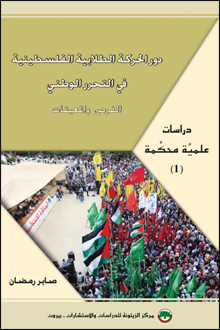 |
Available on:  ||
||  ||
|| ||
|| ||
||
General Introduction
Since 2007, the Palestinian political landscape has been marked by a deep national crisis characterized by the Palestinian schism, stalled reconciliation efforts, the continued suspension of the Palestinian Legislative Council (PLC), declining national aspirations, and the deadlock of the peace process concerning the Palestine issue. This crisis was further reflected in the student and popular mobilization that emerged during the “popular uprising” in October 2015 as an expression of widespread rejection of the prevailing political reality. Against this backdrop, increasing attention has been devoted to the role of the Palestinian student movement in the national liberation struggle and to the need to reorganize it within a unified national framework capable of advancing both liberation and state-building.
The study focuses on strengthening the performance of the Palestinian student movement within universities so that it can function as an effective mobilizing force and a source of national pressure, while contributing to the national liberation struggle. More specifically, it examines how the student movement can be developed or restructured through a coherent national strategy that enhances its capacity during the liberation phase and enables it to engage in the broader national arena whenever issues of political, social, or cultural significance arise. This applies not only in the context of confrontation with Israeli occupation or recurring uprisings, but also under the more stable political and social conditions of a future Palestinian state. At the same time, the study underscores the importance of the internal dynamics of the student movement within universities. Against this backdrop of rapidly evolving developments on the ground, broad student participation in public events, and growing calls for organized action, the paper highlights the need for the student movement to adopt structured measures and activities that clearly articulate its position on the wider political context.
This is further compounded by a deepening crisis within the student movement, marked by a widening gap between shifts in the surrounding political environment, and the political opportunities they generate, and the absence of collective response mechanisms within student structures as a tool of national pressure and as a means of articulating their role and identity. This gap is reflected in weak coalition-building, fragmented organizational alliances, and largely uncoordinated mobilization. Accordingly, student structures require a greater degree of autonomy, in the sense that organizational dependency, as well as relations with university administrations, should not impede the activation and development of the student movement. Such autonomy would enable the formation of effective social and political partnerships, ultimately fostering a more coherent movement grounded in clear objectives and demands within the broader national context.
The researcher Jihad As‘aid argues that the subordination of the student movement to a political party undermines its objectives as a social movement with its own union, political and social goals. In the current Palestinian context, he adds, this dynamic deprives the student movement of broad social and official recognition as a legitimate and influential actor within the national political sphere. Likewise, Thierry M. Luescher-Mamashela contends that student movements’ participation in national liberation struggles confers social and political “legitimacy,” strengthening their cohesion and capacity to engage authorities both during liberation and in the post-independence state-building phase.
Accordingly, a state of stagnation has emerged in unified student mobilization in response to the political schism and the subsequent measures taken at the national and institutional levels of the Palestinian political system. In the West Bank (WB), the Palestinian Authority (PA), and in Gaza Strip (GS), the de facto authorities, both have contributed to tightening constraints on political and institutional activity, whether at the official and governmental level or within popular and civil society networks. Since the onset of the schism, this has effectively deprived the Palestinian arena in both the WB and GS of any broad, organized national student mobilization capable of transcending factional divisions. As a result, efforts to develop a unified student movement, one able to overcome factional and organizational cleavages and lay the groundwork for a more coherent national framework, have been significantly constrained.
In contrast, the Palestinian arena has witnessed strong and active participation in the popular uprising in the Palestinian Territories, raising a key question: why has there been no unified student mobilization at the university level to pressure an end to the political and national schism and to support prisoners in public spaces beyond university campuses, despite the movement’s strong engagement with the uprising? This apparent contradiction warrants closer examination through the study’s central research question: how can the effective national role of the Palestinian student movement in universities be activated and strengthened amid ongoing political and field developments in the Palestinian liberation process? The literature has highlighted this dilemma, offering a range of cautious analyses and interpretations.

Al-Zaytouna Centre for Studies and Consultations, 5/5/2016
Leave A Comment